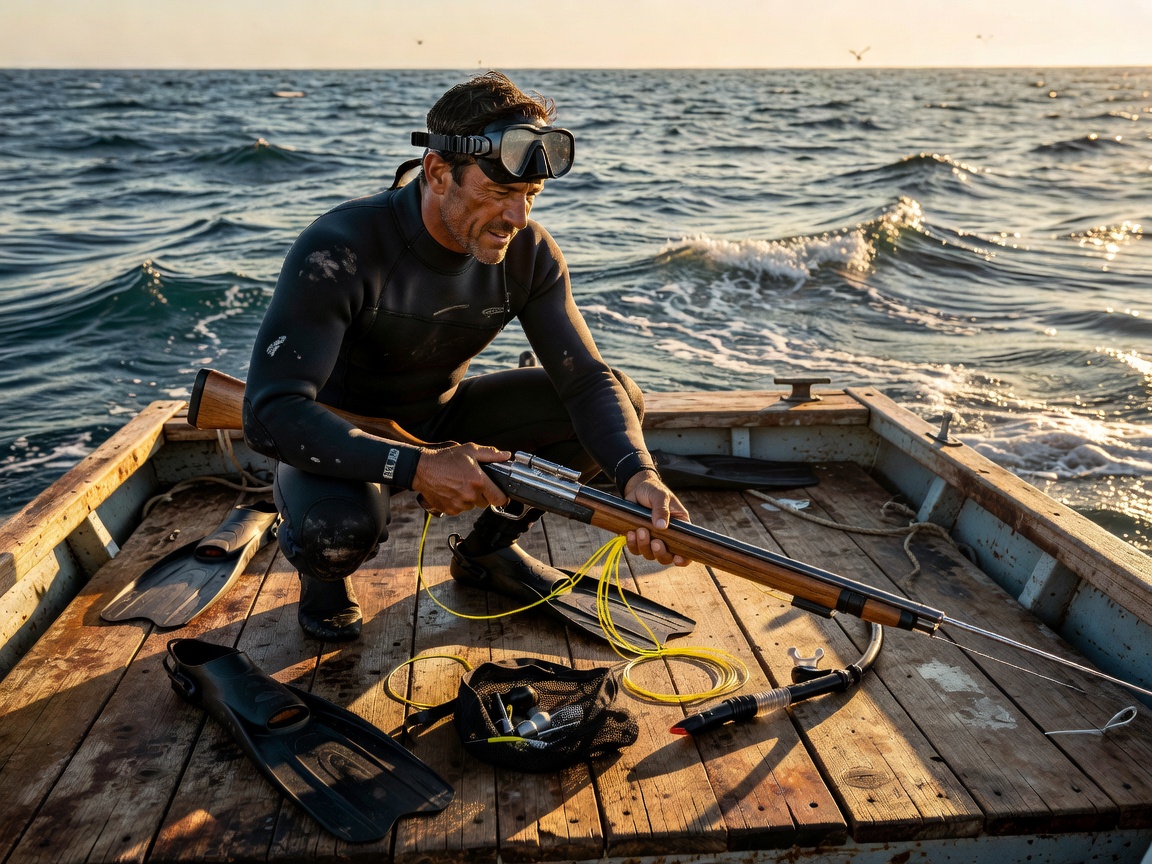
Entering the water without an intimate understanding of your equipment is a liability. Spearfishing gear is highly specialized, evolving from rudimentary tools into precision-engineered apparatus designed to withstand extreme pressure, corrosive saltwater, and intense mechanical stress. This guide strips away the marketing jargon and breaks down the core components you need to understand before assembling your kit.
Spearguns: Band vs. Pneumatic
The primary weapon of choice divides into two distinct categories, each with operational trade-offs based on the hunting environment.
Band Spearguns operate on stored kinetic energy provided by stretched latex rubber bands. They are favored for their silent operation, ease of maintenance, and reliable accuracy. When a band gun misfires or a band snaps, field repairs are often possible. Their length varies drastically; a 75cm setup is ideal for murky reef hunting, while open water demands setups pushing 120cm to 140cm to deliver shafts through pelagic species.
Pneumatic Spearguns utilize a sealed chamber of compressed air to propel the shaft. Unlike band guns, the air is not expelled upon firing, but simply pushes an internal piston. These guns offer immense power in a highly compact profile, making them exceptionally maneuverable in tight caves and heavy kelp. However, their internal mechanics are complex. If an O-ring fails or sand enters the barrel, the gun is entirely out of commission until it can be serviced on a workbench.
Wetsuits: The Open-Cell Advantage
A surfer’s wetsuit will not suffice for prolonged hunting sessions. Spearfishing relies on open-cell neoprene. Traditional wetsuits are lined with nylon on the inside, which allows water to flush through freely. Open-cell suits lack this internal lining; the raw, porous rubber adheres directly to the skin. This creates a near-perfect seal that dramatically slows water circulation and retains body heat.
The trade-off is fragility and the requirement of lubrication. Attempting to don an open-cell suit dry will tear the neoprene and strip the hair from your skin. Divers use a mixture of water and specialized suit lube or baby shampoo to slip into the gear. Furthermore, most spearfishing suits are two-piece designs (high-waisted pants or farmer johns paired with a hooded jacket), eliminating the weak point of a zipper.
Fins: Propulsion Mechanics
Standard scuba fins are short and rigid, designed for slow, methodical movement. Spearfishing demands long-blade fins to maximize thrust with minimal oxygen expenditure. The material dictates the efficiency.
- Plastic/Polymer: Highly durable and cost-effective. Excellent for rock-hopping and beginners, but they suffer from "memory"—over time, the blade loses its snap and remains permanently bent, degrading energy transfer.
- Fiberglass: A solid middle ground. They offer a reactive snap that rivals carbon but can withstand more impact against reef structures without shattering.
- Carbon Fiber: The apex of fin technology. Carbon provides an immediate, explosive return of energy when bent, allowing divers to descend and ascend with vastly less effort. They are, however, expensive and brittle, requiring careful handling around jagged rocks and boat decks.
Masks: Minimizing Internal Volume
As you descend, ambient water pressure increases, compressing the air spaces within your body and equipment. A diving mask contains air, and as this air compresses, the mask will painfully squeeze against your face. To counter this, a diver must exhale a small amount of air through their nose into the mask—a process called mask equalization.
A low-volume mask sits extremely close to the eyes, containing very little air space. This means less of your precious stored oxygen is wasted equalizing the mask at depth. Clear silicone skirts, while popular in scuba, are generally avoided in spearfishing; black or opaque silicone prevents distracting light glare from entering the periphery of your vision.
Weight Belts: The Rubber Imperative
Buoyancy shifts at depth. A wetsuit compresses, making you less buoyant the deeper you go. Nylon weight belts, common in scuba, become loose at depth as the wetsuit compresses, causing the weights to slide around your torso. Spearfishing demands a rubber weight belt. The elasticity of the rubber ensures the belt remains tight against your hips regardless of depth compression, keeping your ballast secure and predictable.